
The Post Office Horizon Scandal and the Westrum Continuum
The Post Office Horizon scandal is one of the most serious miscarriages of justice in modern British history, and it emerged from a pathological organizational culture. From the late 1990s onward, the Post Office, a UK-wide, government-owned organization overseeing a network of post offices across England, Scotland, Wales and Northern Ireland, rolled out the Horizon IT accounting system, developed and maintained by Fujitsu. Many post office branches were operated by self-employed SubPostmasters, often running the branch alongside newsagents or village shops under contracts with the government-owned Post Office.
When the Horizon system began showing unexplained shortfalls, hundreds of sub-postmasters were accused of theft, false accounting, or fraud, with many prosecuted, imprisoned, bankrupted, or socially ruined. Despite persistent complaints from sub-postmasters that the software produced anomalies and was faulty, the Post Office maintained for years that Horizon was “robust” and reliable. The issue came to public attention in the 2010s through campaigning by affected SubPostmasters, investigative journalism, and court action, culminating in a landmark High Court judgment in 2019 that exposed systemic flaws in Horizon and serious institutional failings by the Post Office. This was followed by the quashing of convictions, a statutory public inquiry, and ongoing efforts to provide compensation and accountability.
Applying the Westrum Organizational Culture Continuum (which categorizes cultures as Pathological, Bureaucratic, or Generative) helps us see the systematic pattern of evidence of a pathological organizational culture. The evidence from the public inquiry when viewed through the lens of Ron Westrum’s ‘Response to Anomaly’ continuum, shows the Post Office and Fujitsu responding to anomalies, the unexplained financial shortfalls experienced by SubPostmasters by isolating the SubPostmasters (Encapsulation) attacking those who persisted (Suppression) and denying the existence of systemic issues (Public Relations). They consistently failed to engage in inquiry and contemplate global fixes.
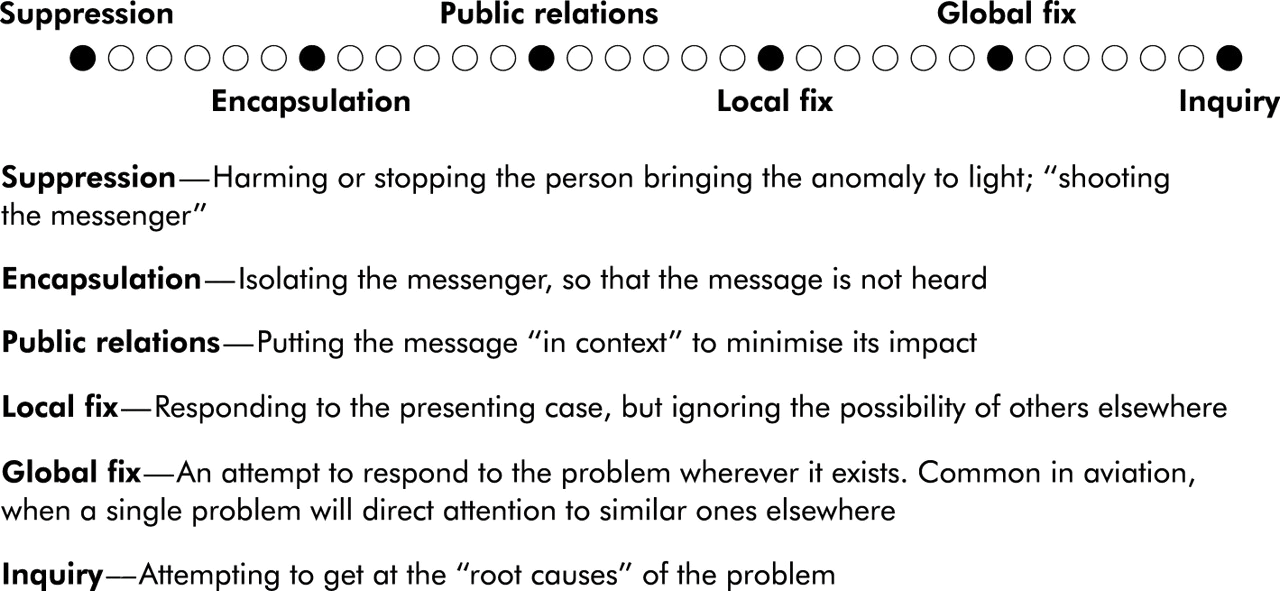
Suppression: Harming or stopping the person bringing the anomaly to light ("shooting the messenger")
The Post Office Horizon IT Inquiry is an independent public statutory Inquiry established to gather a clear account of the implementation and failings of the Horizon IT system at the Post Office over its lifetime. The inquiry is tasked with ensuring there is a public summary of the failings which occurred with the Horizon IT system at the Post Office leading to suspension, termination of SubPostmasters’ contracts, prosecution, and conviction of SubPostmasters.
The evidence given to the Inquiry is public, with hearings broadcast on YouTube and transcripts and evidence available online. It shows criminal prosecution as the Post Office’s most potent tool of suppression, using historic private prosecutorial powers to harm SubPostmasters like Seema Misra (imprisoned while pregnant) and Janet Skinner, ensuring they were not simply told they were wrong, they were labeled as criminals and punished. Aggressive civil litigation was used to try to bankrupt Lee Castleton after he challenged a £27,000 shortfall, with the intention of making him serve as a warning to others. Finally, in the Bates v Post Office (2019) litigation, the Post Office spent over £100m of public money to try to "crush" the claimants.
Encapsulation: Isolating the messenger so that the message is not heard.
"You are the only one" was a recurring theme in SubPostmasters testimony when they raised an anomaly with the Horizon ‘help’ desk. Alan Bates and Jo Hamilton shared how when they called the Horizon Helpdesk to report bugs, they were told: "No one else is having this problem." This isolation was a deliberate tactic to ensure the message from SubPostmasters remained unheard, discouraging them from forming a collective voice or community of informed users. SubPostmasters who reached a settlement were required to agree to Non-Disclosure Agreements (NDAs) again encapsulating them and preventing them from communicating with others.
Public Relations: Putting the message "in context" to minimize its impact.
"Horizon is Robust" was the line taken by former CEO Paula Vennells and other executives who repeatedly used Public Relations (PR) in parliamentary briefings and public statements. Evidence shows this PR shield was designed to minimize negative impact and protect the Post Office reputation, even as internal briefings made it clear that there were known bugs and that harm had been done to many SubPostmasters. PR strategies included briefing against "dissident" SubPostmasters, framing them as disgruntled individuals or incompetent operators, to minimize the impact of their reports of technical anomalies in the software, and trying to manage and potential replace the independent forensic accountancy and investigations firm Second Sight, appointed by the Post Office in 2012 to review complaints from sub-postmasters about the Horizon computer system.
Local Fix: Responding to the presenting case, but ignoring the possibility of others elsewhere.
The Post Office and Fujitsu sometimes named the bugs discovered after the Post Office branch where they were first noticed, associating the bugs to users, rather than the system activity or a feature of the circumstances that led to it.Instead of investigating the bugs systematically and seeking their elimination, the response seems to have been on of treating anomalies as local issues - even if experienced by hundreds of SubPostmasters who were seeing shortfalls - and part of the local fix was accusing the SubPostmaster of theft or bad accounting, and demanding they "repay" the shortfall out of their own pockets to make the books balance. Testimony from Fujitsu engineers revealed they helped the local fix with super-user admin privileges to make hidden "balancing transactions", manually inserting changes to databases into individual branch accounts (without the SubPostmaster’s knowledge) to ‘fix’ these specific local discrepancies. While these local fixes continued for years the global system was promoted as “robust”.
Global Fix and Inquiry: An attempt to respond to the problem wherever it exists and attempting to get at the "root causes" of the problem
There is no compelling evidence of Post Office leaders or those responsible for their governance and oversight engaging in behaviors to respond with global fixes and an inquiry. The Post Office organizational culture was strongly pathological with some bureaucratic elements for nearly two decades. A "Global Fix" would have involved a system-wide suspension of prosecutions and a total robust audit of the Horizon system and an admission of failure and guilt and compensation. The independent investigative firm appointed in 2012 (Second Sight) was asked to review ‘cases’ of SubPostmasters (cases raised by Members of Parliament on behalf of their constituents). The Post Office response was to make the process difficult and seek to suppress the findings, encapsulate Second Sight and engage in public relations. Inquiry only arrived when forced on the Post Office and Fujitsu, first in a revealing High Court case and ruling in 2019 and subsequently the statutory inquiry(2020–present). The lack of a culture of inquiry - a core component of a generative organizational culture - has sadly eventually led to the best documented example of bad leadership behaviours changing a bureaucratic culture into a pathological culture, where individuals continuously placed the protection of their personal reputations over their fiduciary duty and in doing so, damaged the lives of thousands of people.
